


How Almen strips, arc height, saturation curves and production verification define a controlled peening-intensity result
Almen intensity is a standardized measure of the effect of a peening stream. It is reported as an arc-height value together with the Almen strip designation and is determined from controlled exposure data under the invoked saturation procedure. One strip reading does not establish intensity. The result is also not a direct measurement of component coverage, residual stress or fatigue performance.
What is Almen intensity?
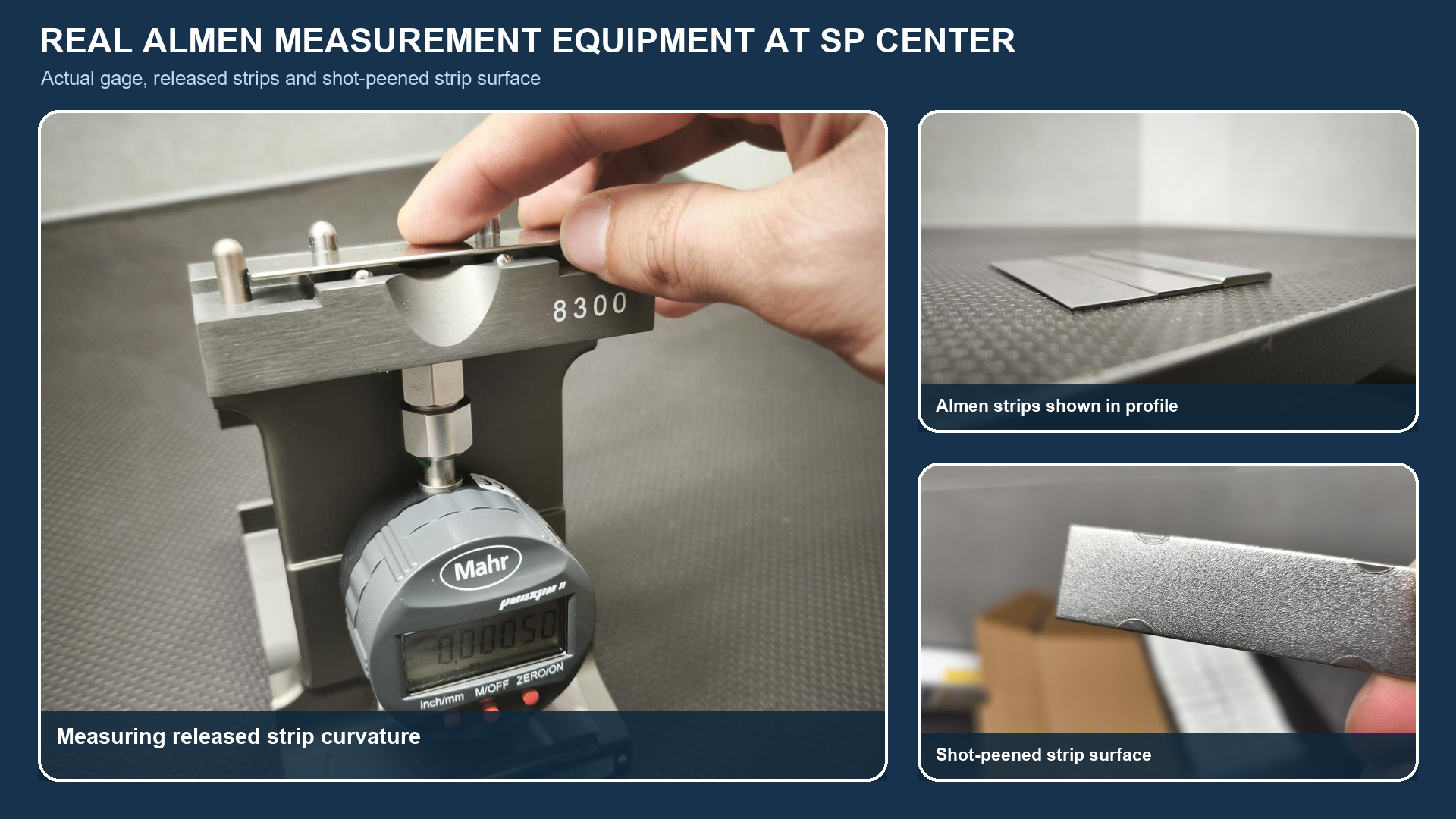
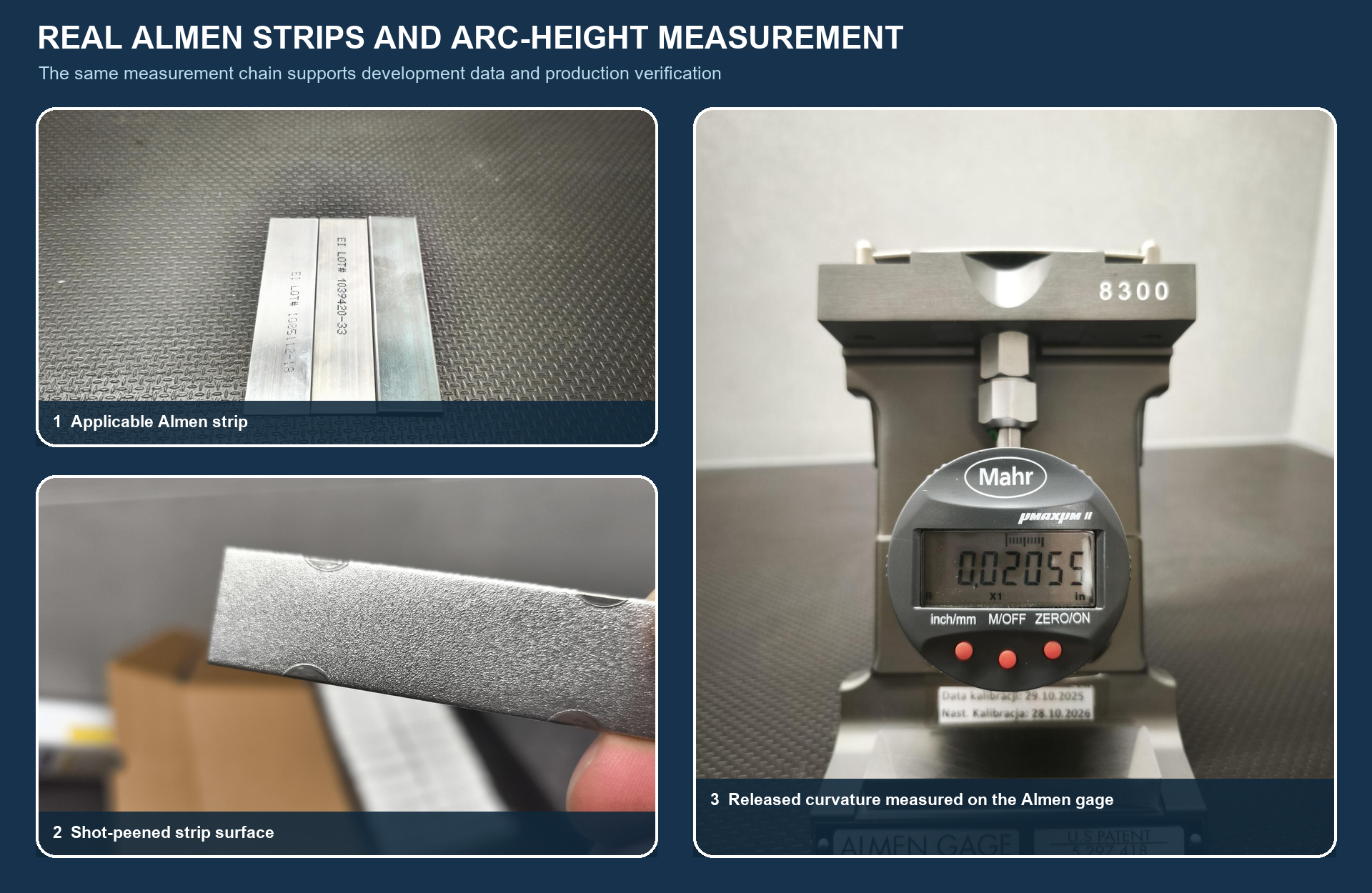
A conforming spring-steel Almen strip is fixed to the specified holder and exposed to the peening stream. After removal, the strip curves because the two sides respond differently to the impacts. The applicable Almen gage measures the resulting arc height. Multiple fresh strips exposed at controlled values provide the data used to determine the saturation point and intensity.
| Term | Working meaning | Common error |
|---|---|---|
| Arc height | Curvature measured after a conforming exposed strip is released and placed on the applicable gage | Calling any single reading the process intensity |
| Saturation curve | Evaluated relationship between controlled exposure and arc height for one defined stream configuration | Selecting the highest point or expecting a perfectly flat curve |
| Almen intensity | Arc height at the determined saturation point, reported with the strip designation | Reporting pressure, wheel speed or a number without N, A or C |
| Verification | Evidence that the released configuration continues to deliver the required intensity | Treating the original development curve as automatic release for every later job |
Table 1. Arc height, saturation, intensity and verification are related but distinct.
Why are the strip, holder and gage a measurement system?
Strip type and condition, holder geometry and cleanliness, fastening, gage condition and zeroing, measurement orientation, operator technique and traceability can all influence the record. A strip must not be flattened and reused. Each curve point requires a fresh conforming strip and a traceable exposure value.
How is intensity notation read?
A notation such as 0.012–0.016A contains an acceptable arc-height range and the A-strip designation. In an inch-based convention, the numerical range represents inches; metric documentation must identify millimetres explicitly. The governing drawing or specification must define the applicable convention. The suffix is not a unit that can be omitted, and the number is not a pressure or residual-stress value.
| Strip family | Relative application | Selection rule |
|---|---|---|
| N | Lower-intensity conditions | Use only where allowed by the governing requirement and expected measurement range |
| A | Intermediate-intensity conditions | Report the A designation with the arc-height value or range |
| C | Higher-intensity conditions | Do not substitute for another family or convert by intuition |
Table 2. N, A and C strips cover different relative measurement ranges and are not freely interchangeable.
How does the saturation curve establish intensity?
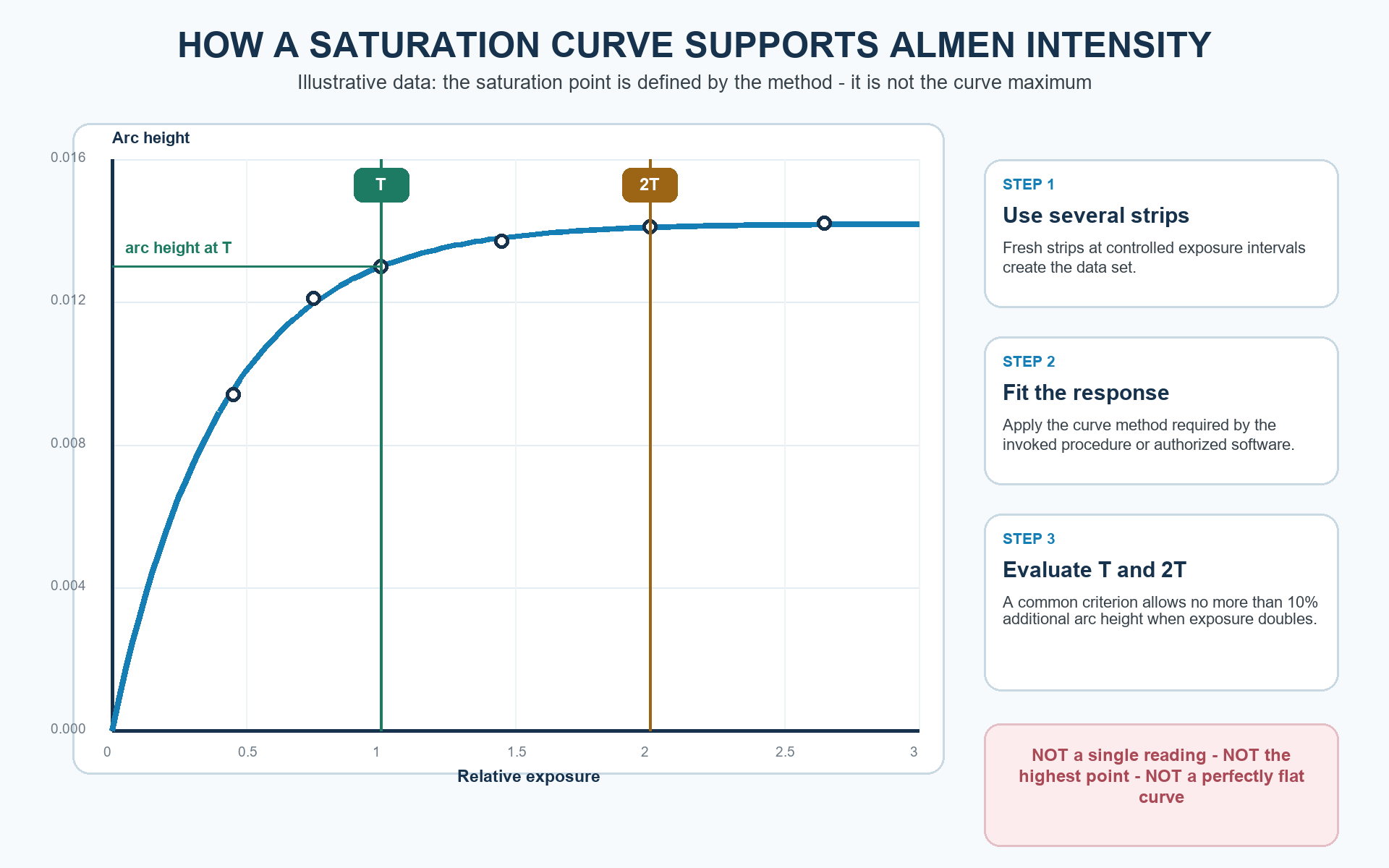
A saturation curve relates measured arc height to controlled exposure for one unchanged stream configuration. Early exposure increments generally produce larger increases in arc height; later increments add less. The governing evaluation method determines the saturation point from the complete dataset. The point is not the maximum reading, and one convenient pair of measurements cannot replace the required curve.
Where the invoked procedure uses the classical 2T criterion, doubling exposure from T to 2T may increase the evaluated arc height by no more than 10%. The exact calculation, curve method, data requirements and any computer-generated evaluation must come from the governing revision.
What is the difference between establishing and verifying intensity?
| Stage | Controlled action | Required output |
|---|---|---|
| Define | Confirm treatment zones, intensity range, strip type, media and invoked documents | Unambiguous technical requirement |
| Configure | Fix equipment, media, holder locations, fixture and delivery or motion conditions | Traceable setup identity |
| Expose | Use fresh conforming strips at planned increasing exposure values | Recorded exposure and strip identification |
| Measure | Use the applicable gage, zeroing, orientation and measurement procedure | Traceable arc-height data |
| Evaluate | Apply the invoked saturation-curve method or authorized software | Accepted curve and reported intensity with strip designation |
| Release and verify | Freeze the production route and define locations, frequency and reaction rules | Approved instruction and verification record |
Table 3. Development establishes the basis; production verification confirms the released route under the defined control plan.
Verification is not permission to adjust the recipe until a convenient strip falls inside the range. Media, pressure or wheel speed, flow, nozzle or wheel condition, angle, stand-off, holder position, fixture, motion, maintenance and measurement equipment can all affect the result. The change-control plan determines when a new curve, mapping, verification or qualification is required.
Which process variables can change Almen intensity?
- Media family, size, density, hardness, shape and operating condition.
- Particle velocity and the population that reaches the verification location.
- Air pressure, nozzle design, hose losses and media flow in pneumatic systems.
- Wheel speed, feed and distribution in centrifugal systems.
- Impact angle, stand-off, fixture interference, holder position and stream access.
- Strip, holder, gage, measurement technique and software control.
Why is intensity not coverage, residual stress or performance?
| Engineering question | Evidence | Not interchangeable with |
|---|---|---|
| What standardized stream response is produced? | Almen intensity | Coverage or residual stress |
| Has the specified component area been completely impacted? | Approved coverage assessment | Almen intensity |
| What stress state exists in the component? | Specified component measurement, such as an approved diffraction method | Almen-strip arc height |
| How does the component perform under representative loading? | Approved fatigue, durability, analysis or service evidence | A conforming intensity record alone |
| Which settings reproduce the route? | Controlled media, delivery, fixture, motion and monitoring records | The intensity value without configuration identity |
Table 4. Process verification, component surface acceptance and component validation require separate evidence.
A conforming intensity result may be necessary for a controlled route, but it is not a performance guarantee. Two processes can produce similar Almen results while giving different component outcomes because media, angle, material, hardness, geometry, coverage and sequence differ.
What should happen when a result is out of range?
| Finding | Why it matters | Controlled response |
|---|---|---|
| Intensity below the lower limit | The standardized stream response does not meet the released requirement | Contain the affected scope, investigate and follow the approved verification and disposition route |
| Intensity above the upper limit | Greater severity is not automatically acceptable | Treat as nonconforming unless an authorized technical disposition accepts the affected product and process condition |
| Curve does not support a result | Poor range, spacing, scatter or control makes the derivation unreliable | Repeat the study with an adequate controlled dataset |
| Result trends within the range | Drift can precede a limit failure | Apply the approved trend and reaction plan |
| Configuration changed | The original mapping or verification basis may no longer represent production | Review whether re-verification, remapping or requalification is required |
Table 5. An unsupported or out-of-range result requires a documented technical response, not silent retesting or retrospective record changes.
How should an intensity requirement be specified?
State the full lower and upper limits, strip designation, units or notation convention, governing documents and revisions, treatment and exclusion zones, coverage requirement, media restrictions, verification locations and frequency where applicable, qualification scope, change controls and required records. Avoid incomplete notes such as “peen to 0.014” or “use standard intensity.”
Frequently asked questions
What does Almen intensity measure?
It measures the standardized response of an Almen strip to a defined peening stream and procedure. It does not directly measure component residual stress, coverage or fatigue life.
Can one Almen strip determine peening intensity?
No. One strip gives one arc-height value at one exposure. Determining intensity requires the dataset and saturation evaluation specified by the governing procedure.
What does the A mean in 0.014A?
A identifies the Almen strip family used for the result. The suffix is part of the intensity notation and must not be omitted or freely exchanged for N or C.
Is the saturation point the maximum arc height?
No. Saturation is the point defined by the invoked curve criterion. It is not simply the highest reading, and the curve does not need to become horizontal.
What does the 2T criterion mean?
Where the governing method applies the classical 2T criterion, doubling exposure from T to 2T may increase the evaluated arc height by no more than 10%. The complete calculation and acceptance rule must follow the invoked procedure.
Does a conforming intensity prove component coverage?
No. Intensity characterizes the standardized stream response. Coverage evaluates impact completion on the specified component area using a separate approved method.
Can two routes have the same intensity but different component results?
Yes. Media, impact angle, material, hardness, geometry, coverage and manufacturing sequence can differ even when the standardized Almen result is similar.
What should happen after an out-of-range result?
Follow the approved reaction plan: preserve the original result, contain the affected scope, investigate the measurement and process chain, correct the cause, repeat the required verification and obtain product disposition.
Key takeaways
- Almen intensity is the saturation arc height reported with the strip designation.
- One strip reading is a data point, not a newly established intensity.
- Saturation is a defined curve result, not the curve maximum.
- N, A and C designations are part of the result and are not freely interchangeable.
- Intensity, coverage, residual stress, machine inputs and fatigue performance require separate evidence.
- Out-of-range results require containment, investigation, correction, verification and authorized disposition.
Related SP Center guides
Technical references
1. SAE J442_202602: Tools for Peening Intensity Determination and Verification, revised February 2026
2. SAE J443_202512: Procedures for Determining and Verifying Peening Intensity, revised December 2025
3. SAE J2597_201709: Computer Generated Shot Peening Saturation Curves
4. SAE J2277_202301: Shot Peening Coverage Determination, revised January 2023
5. SAE AMS2430U: Shot Peening, revised April 2018
Standards note: Use the complete revision invoked by the drawing, contract and customer requirements.
Author: Paweł Kmieć
Discuss your shot peening requirement: +48 519 772 773 | [email protected]