


How to control incoming lots and the operating mix without confusing media conformance with intensity or component acceptance
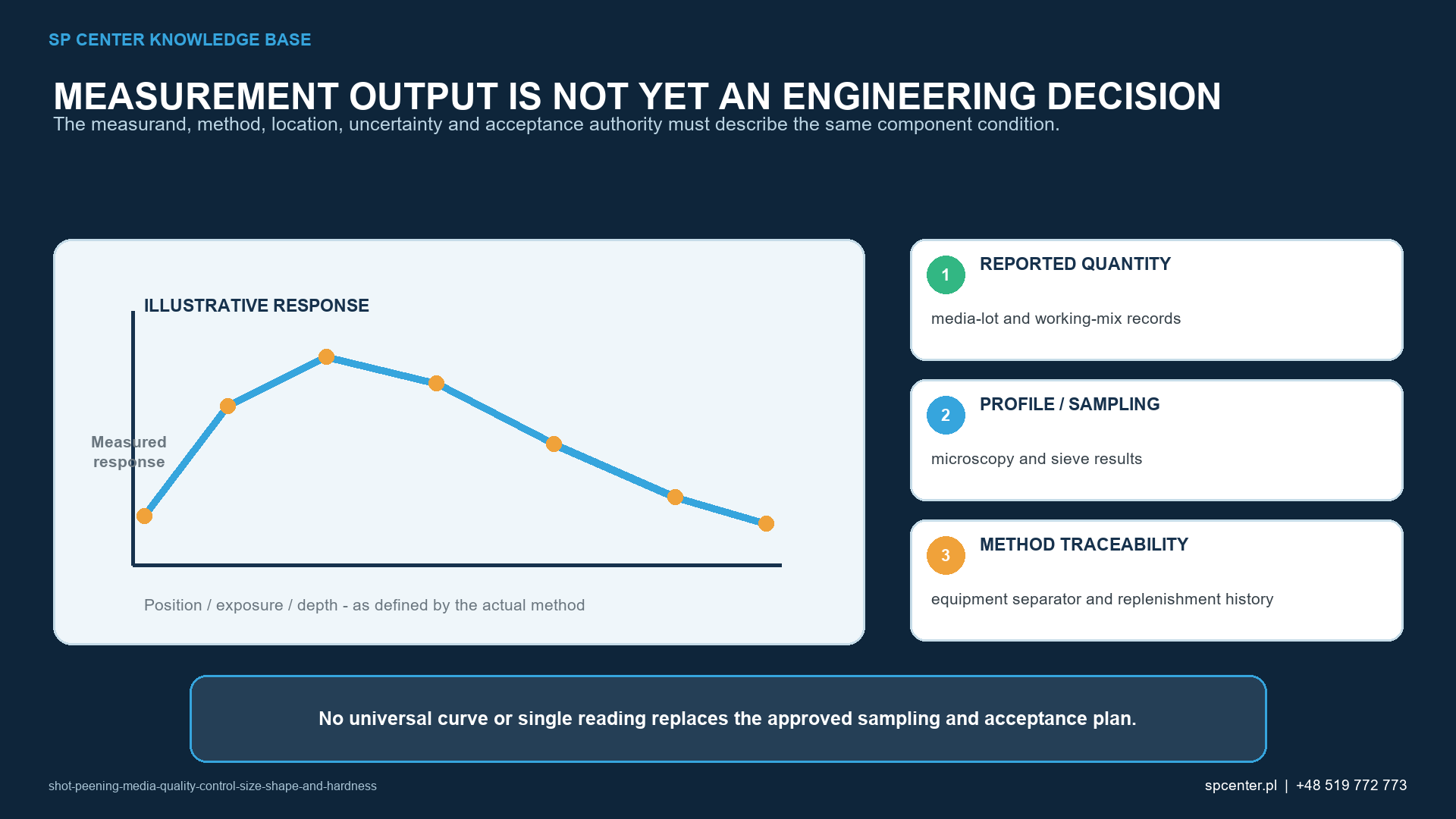
Shot peening media quality control must establish more than a commercial media name. Material, size distribution, particle shape, hardness and operating-mix condition influence acceleration, impact behaviour, surface texture, contamination risk and process stability. These characteristics require defined sampling and acceptance methods. A conforming media report supports the qualified route, but it does not replace Almen intensity verification, coverage inspection or component-surface acceptance.
Which media characteristics must be controlled?
| Characteristic | Engineering effect | Representative control route |
|---|---|---|
| Material and density | Influence acceleration, impact response, contamination compatibility and durability | Supplier certification, identity control and material-specific verification when required |
| Size distribution | Affects particle velocity, impact population, intensity response, access and surface texture | Representative sampling and sieve or other approved size-distribution method |
| Particle shape | Rounded, broken, angular, elongated or defective particles produce different contact conditions | Approved microscopic classification and applicable acceptance limits |
| Hardness | Influences particle deformation, durability, component response and media breakdown | Specified hardness method, prepared sample and qualified measurement equipment |
| Operating-mix condition | Combines fresh-media input, wear, breakage, replenishment and classification performance | Periodic process sample, trend review and reaction limits |
Table 1. The applicable general media specification, detail specification, drawing and customer supplement determine the actual characteristics, methods and limits. A supplier designation alone is not a complete acceptance criterion.
Why is size a distribution rather than one diameter?
Production media contain a population of particles. The proportion retained or passing defined sieves, or the equivalent result from another approved method, is therefore more meaningful than a single average diameter. Oversize material may create access or surface-damage risk, while excessive undersize can change impact population and intensity response. The governing specification defines the required distribution and method.
How should particle shape be evaluated?
Particle shape influences the contact condition at impact. Rounded conditioned media, angular fragments, elongated cut-wire remnants, broken particles and fused or defective shapes should not be treated as equivalent. Shape evaluation requires a representative sample, suitable preparation and magnification, defined classification categories and the acceptance limits invoked for the media family. Descriptive photographs are useful only when they belong to the approved method.
What does the hardness result establish?
Hardness supports verification of media material and condition and influences deformation, durability and component response. The result depends on the specified test method, sample preparation, particle size, support, indentation location and equipment status. A hardness value from an unsuitable particle or preparation cannot be accepted merely because it matches the expected range.
How do incoming-lot and operating-mix controls differ?
| Control stage | Question | Evidence |
|---|---|---|
| Specification review | Which general and detail media requirements, revisions and customer supplements apply? | Controlled requirement matrix and approved media designation |
| Incoming lot | Does the delivered lot match identity, certification, packaging and invoked acceptance criteria? | Certificate review, lot identification and required receiving tests |
| Machine charge | Was the correct released media introduced without mixing or contamination? | Issue record, container identity, line clearance and charge traceability |
| Operating mix | Does the recirculating population remain within the qualified condition? | Representative sample, size and shape results, contamination check and trend |
| Nonconformance | Which product and process interval may have used an unacceptable mix? | Containment window, investigation, technical disposition and restoration evidence |
Table 2. The operating mix can diverge from the original certificate through wear, replenishment, classifier performance and contamination. Receiving acceptance therefore does not remove the need for in-process control.
How should a representative sample be obtained?
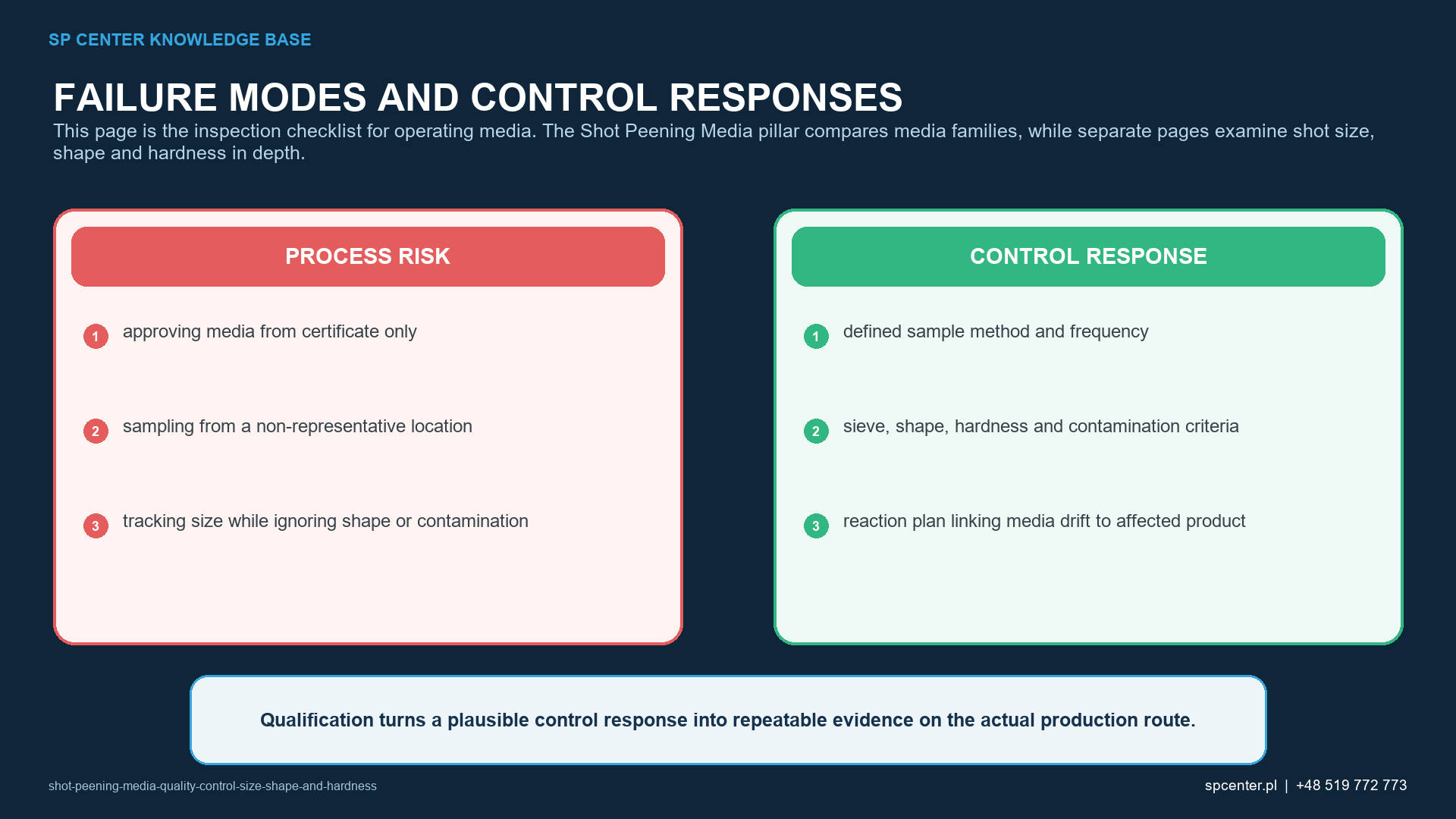
The sampling plan should address the actual decision: supplier lot acceptance, machine charge, operating stream or a suspected contamination event. Samples should be taken at defined locations and times using clean identified equipment, with sufficient quantity for all required tests. A convenient scoop from the top of a static container may not represent segregation within a lot or the recirculating stream.
Sample reduction must also preserve the distribution. Splitting or dividing methods should avoid preferential loss of fine, large, light or irregular particles. The sample identity must remain linked to the supplier lot, machine, date, operating condition and product window where required.
Which findings require containment?
| Finding | Possible cause | Required review |
|---|---|---|
| Excess undersize or broken particles | Wear, classifier setting, excessive recycle or unsuitable media durability | Stream stability, surface condition, intensity history and separator performance |
| Excess oversize or mixed designation | Wrong addition, sieve damage, supplier or handling error | Lot identity, operating mix, access risk and product containment |
| Angular or elongated particles above the applicable limit | Fracture, poor conditioning or incorrect media type | Surface-damage risk, shape-analysis method and affected product |
| Hardness outside requirement | Wrong material, heat-treatment variation or unsuitable test preparation | Material identity, measurement validity, durability and component response |
| Foreign particles | Cross-contamination, maintenance debris or incoming-component carry-over | Contamination investigation independent of intensity and coverage |
Table 3. Restoring the media system is only part of the response. The investigation must determine whether parts processed since the last acceptable evidence require inspection, engineering review, customer disposition or rejection.
What records demonstrate media control?
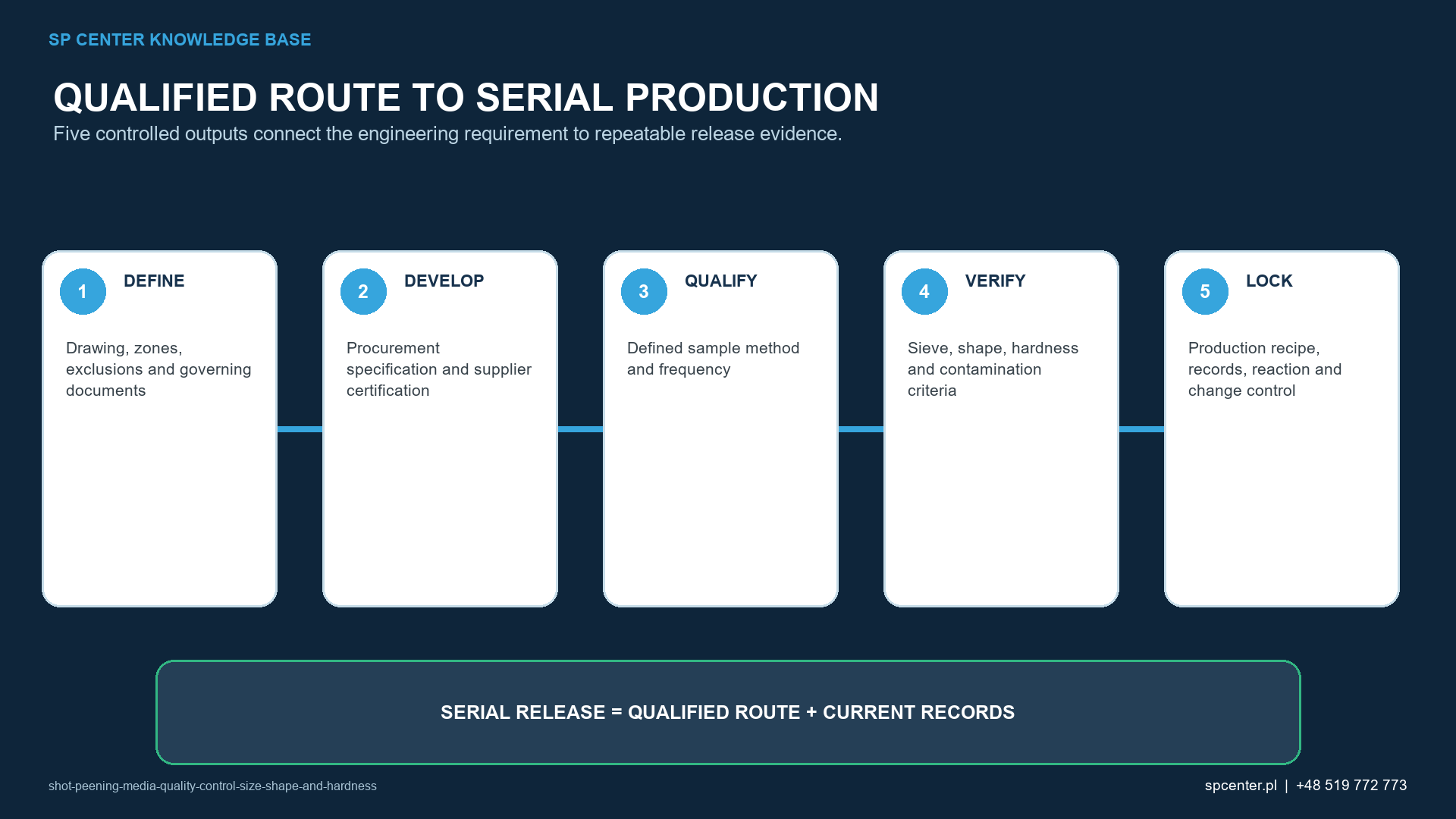
- Invoked general and detail media specifications and revisions.
- Supplier, media designation, material, lot, certificate and receiving status.
- Storage, issue, machine charge, replenishment and disposal records.
- Sampling location, method, date, quantity and sample identity.
- Raw size, shape, hardness and contamination results with equipment status.
- Acceptance decision, trends, nonconformances, containment, restoration and release.
Frequently asked questions
Why must size, shape and hardness be controlled separately?
Each characteristic changes the peening stream and surface response through a different mechanism. A conforming nominal size does not prove acceptable particle shape, hardness, material identity or cleanliness.
Is the supplier certificate enough for production use?
Only when the governing requirements and approved receiving plan permit certificate-based acceptance. Lot identity, packaging, traceability and any required receiving tests still have to be controlled.
What is the difference between incoming media and the operating mix?
Incoming media is the delivered lot. The operating mix is the recirculating population in the machine after additions, wear, breakage, classification and possible carry-over. Both may require separate acceptance evidence.
Does correct Almen intensity prove media conformance?
No. Intensity verifies the effect of the peening stream at a defined reference condition. It may detect some process drift but does not identify size distribution, shape defects, hardness or contamination.
How often should the operating mix be checked?
Use the frequency invoked by the specification, customer requirement and approved process plan. Risk, stability and change history may justify additional checks; no universal interval should be invented.
What happens after an out-of-limit media result?
Stop or contain the affected process as required, establish the last acceptable evidence, identify the affected product window, investigate the cause, restore the media system and complete the approved disposition and re-verification route.
Key takeaways
- Media quality is a system of material, size, shape, hardness, cleanliness and operating-mix condition.
- Incoming-lot and operating-mix control answer different questions.
- Representative sampling is necessary before any analytical result can support acceptance.
- Correct intensity does not prove media conformance, and media conformance does not prove component coverage.
- Out-of-limit results require both media-system restoration and product-window disposition.
Related SP Center guides
Technical references
1. SAE AMS2431E: Peening Media, General Requirements, revised April 2023
2. SAE J444_202306, Cast Shot and Grit Size Specifications for Cleaning and Peening
3. SAE AMS2430U: Shot Peening, revised April 2018
4. SAE ARP7488: Peening Design and Process Control Guidelines, issued January 2018
Standards note: The applicable detail specification, drawing, contract, customer requirements and invoked revisions remain authoritative.
Author: Paweł Kmieć
Discuss your shot peening requirement: +48 519 772 773 | [email protected]