


Connect each production lot to the approved requirements, configuration, actual process data, component results, abnormal events and authorized release
Shot peening repeatability means reproducing the qualified process and component result within controlled limits from lot to lot. A stable display or identical nominal recipe is insufficient. The record must show that the correct part and requirements, machine, program, fixture, media, stream, motion, inspection system and release decision all remained in the approved state.
What does “batch” mean in shot peening control?
A batch or production lot must be defined by the governing quality system and job requirements. It may group parts of one identity and condition processed under one controlled setup, but the definition cannot be invented after an event to reduce the apparent extent of nonconformity.
The batch record should reconcile input quantity, accepted quantity, rejected or held parts and any authorized rework. Mixed part revisions, materials or process routes require explicit separation and traceability.
| Control class | Typical variables or checks | Frequency principle |
|---|---|---|
| Job and product identity | Part number, revision, serial or lot, quantity, treatment zones, exclusions and customer requirements | Verify before work and when the job or lot changes |
| Authorized configuration | Machine, program revision, fixture, nozzle or wheel arrangement, mask and approved route | Verify before the batch and after any interruption or configuration change |
| Cycle inputs | Air pressure or wheel speed, media mass flow, exposure time, traverse, rotation, position and alarms | Monitor or record at the frequency required by the invoked process and equipment class |
| Media system | Media identity, operating mix, size, shape, hardness, contamination, separator and replenishment | Lot, shift or periodic checks as defined by the governing control plan |
| Process outputs | Almen intensity, saturation validity and component coverage | At the specified verification points; intensity and coverage remain separate |
| Component acceptance | Surface damage, roughness, dimensions, cleanliness, quantity and any required NDT | Per part, sample, batch or periodic plan as explicitly authorized |
Table 1. Monitoring frequency follows the function and invoked requirement rather than one universal checklist.
Which controls belong before the batch starts?
Verify the contract review, drawing and specification revisions, treatment and exclusion map, material and heat-treatment condition, part identity and quantity. Then verify machine and program revision, fixture and mask identity, nozzle or wheel setup, media identity and operating-mix status, calibration or verification status and operator authorization.
A correct program on the wrong machine or fixture is not the qualified route. Electronic selection should be protected against unauthorized revision and manual overrides; physical setup still requires an effective verification method.
Which variables should be captured during the cycle?
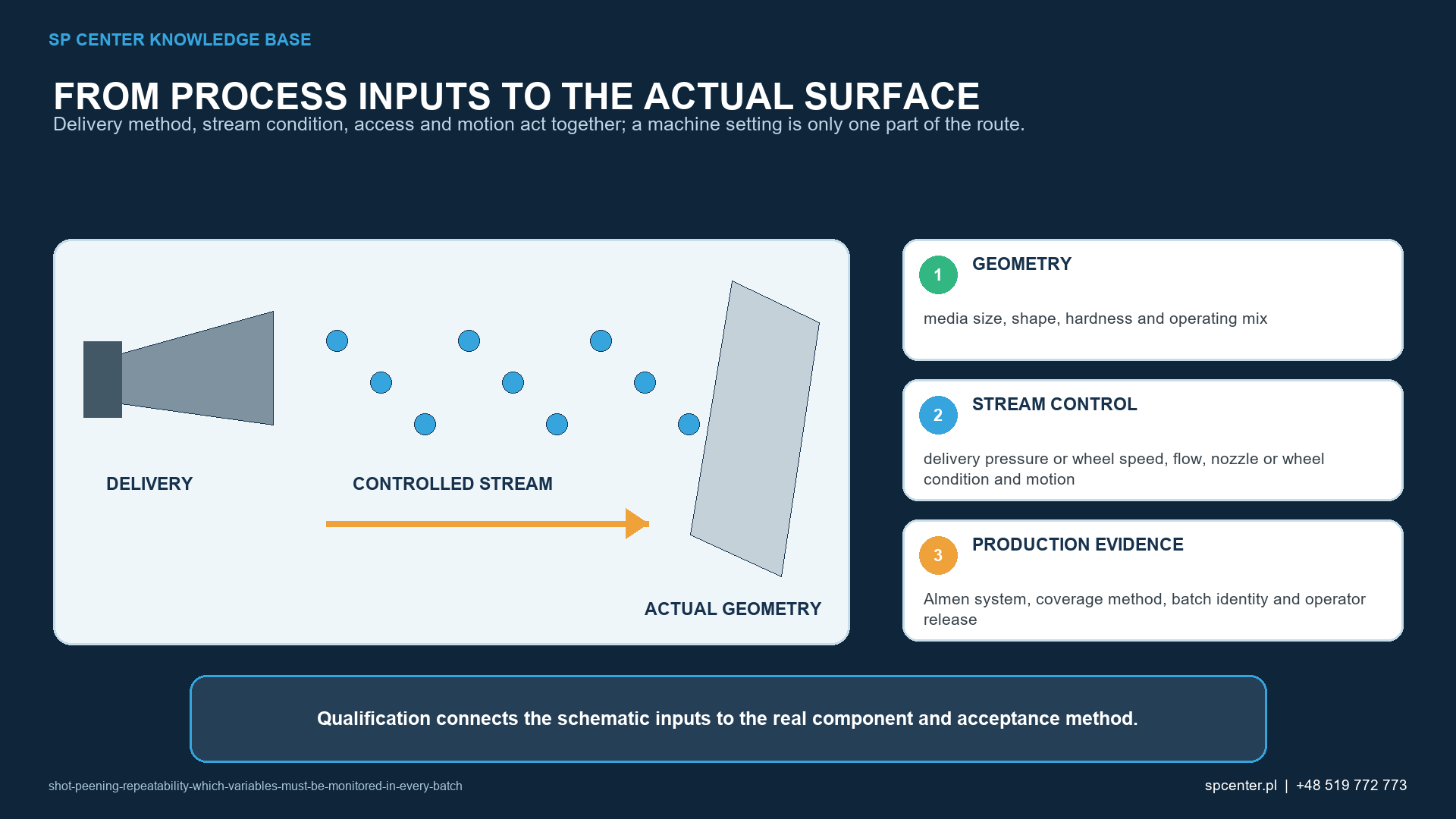
For pneumatic systems, relevant data can include air pressure, media mass flow, exposure, nozzle position, distance, angle and part motion. For wheel systems, wheel speed, media flow, hot-spot location, part motion and exposure can be critical. The exact monitored set comes from the invoked process and qualification.
Record actual values with units, timestamps and the relevant sensor or device identity. A setpoint alone does not show what occurred. Alarm limits, data-loss detection, bypass status and restart logic must be qualified so an abnormal cycle cannot appear normal.
How is the media system controlled between batches?
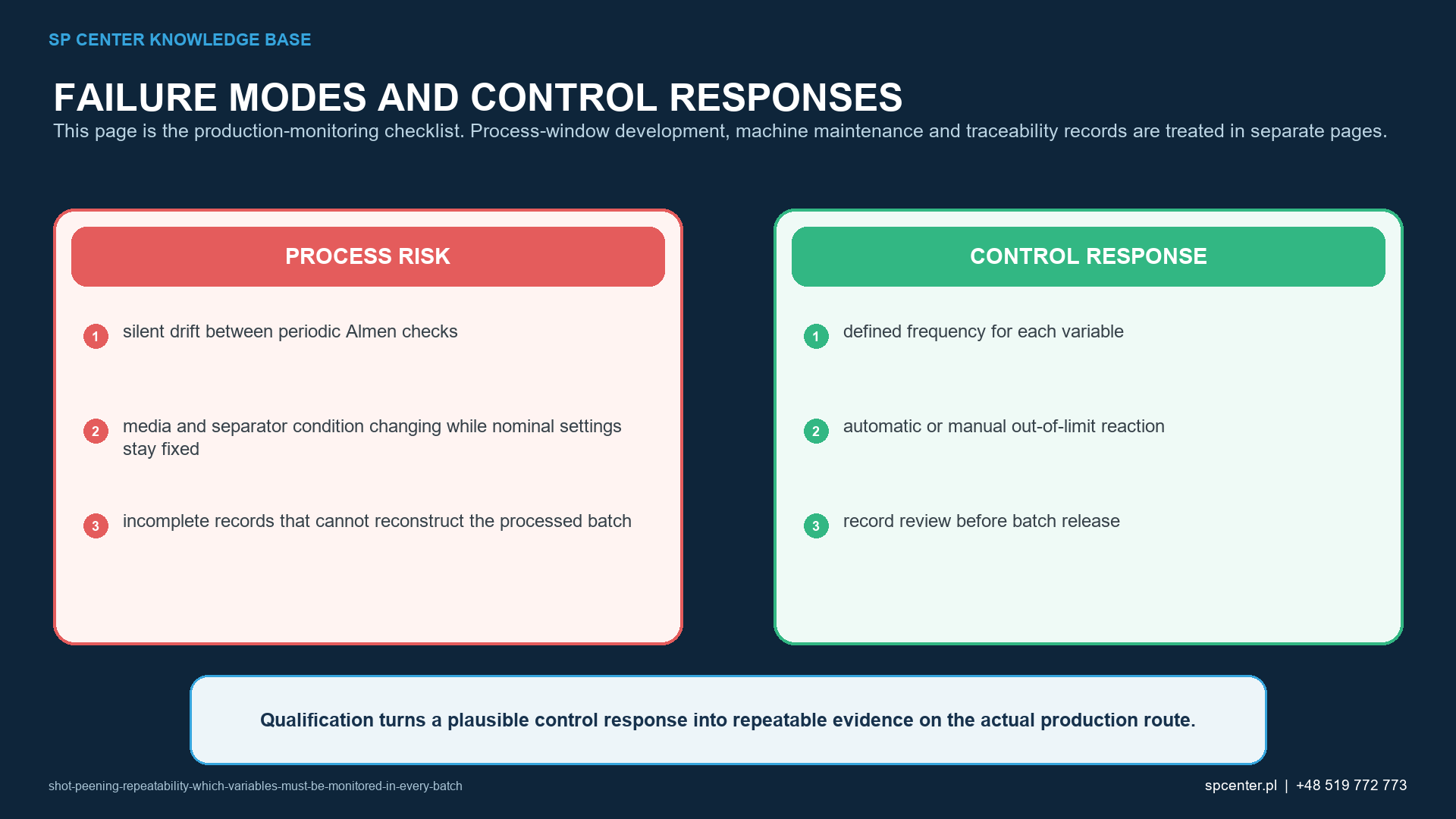
Repeatability depends on media material, size distribution, hardness, shape and operating condition. New-media certificates do not replace operating-mix inspection. Wear, fracture, replenishment, separator efficiency, foreign-media carryover and contamination can change impact behaviour even when machine setpoints remain stable.
Define sampling location, sample preparation, test method, frequency, acceptance and reaction. A sample taken from a convenient stagnant area may not represent the media delivered to the nozzle or wheel.
How do intensity and coverage fit the monitoring plan?
SAE J442 and J443 define Almen tools and procedures for determining and verifying peening intensity; SAE J2277 addresses component coverage. The governing process specification establishes when intensity verification and saturation evidence are required. Coverage is assessed separately on the required component zone.
Do not use one conforming Almen strip to override incomplete coverage, a damaged edge or unacceptable roughness. Conversely, visually complete coverage does not prove the stream was within its approved intensity range.
What makes a batch record auditable?
| Batch-record field | Minimum decision value | Common weakness |
|---|---|---|
| Requirement source | Exact drawing, specification, purchase order and procedure revisions | Only a generic process name is recorded |
| Product traceability | Part and lot or serial identity, quantity accepted, rejected and reworked | Counts do not reconcile or mixed lots are not separated |
| Process configuration | Machine, program, fixture, media, nozzle or wheel setup and treatment sequence | A program name is recorded without revision or protected access |
| Measured data | Actual values, units, timestamps, sampling point, device or sensor identity and result | Only ‘OK’ or rounded setpoints are stored |
| Events and interruptions | Alarms, bypasses, stoppages, media additions, maintenance and restart verification | The normal record hides an abnormal cycle |
| Release decision | Coverage and component acceptance, reviewer, deviations and authorized disposition | Almen conformity is used as the sole lot-release evidence |
Table 2. A defensible record contains actual decision data rather than generic confirmations.
Where a computer-monitored process such as one governed by AMS2432 is invoked, retain the required process data in the specified form and protect record integrity. Computer monitoring does not remove the need to verify media, fixtures, coverage, component condition and personnel actions.
How should alarms, interruptions and missing data be handled?
| Signal | Immediate action | Extent review |
|---|---|---|
| Critical input outside limit or missing data | Stop or alarm according to the approved reaction plan and preserve the record | Contain product since the last verified acceptable condition |
| Media identity or condition uncertain | Segregate the media and prevent further use | Identify machines, batches and time interval exposed to the suspect media |
| Intensity result nonconforming or saturation evidence invalid | Stop release and verify test setup, strip, holder, exposure and machine state | Assess all product covered by the relevant verification interval |
| Coverage incomplete or excluded zone exposed | Segregate the component and protect against informal reprocessing | Review program, access, fixture contacts and other parts in the route |
| Damage, roughness or dimensions fail | Contain affected parts and stop the responsible configuration | Determine whether material, geometry, media or equipment drift affects other lots |
| Trend approaches a limit despite conforming points | Initiate preventive review before an out-of-control event | Compare shifts, operators, media age, maintenance and measurement system |
Table 3. Reaction begins with preservation and containment, then expands according to the affected verification interval.
Do not simply reset an alarm, rerun a strip or complete a missing field from memory. Establish the actual condition, identify the last verified acceptable state and determine whether the affected scope is one part, one batch, several batches or a longer time interval.
How can trend review improve repeatability?
Run charts or other suitable methods can reveal drift in intensity, pressure, media flow, cycle time, media size distribution, reject rate or surface response while individual results still conform. Compare changes with media age, replenishment, maintenance, nozzles or blades, shifts and measurement-system behaviour.
A trend alarm is not automatically a product rejection unless the controlled plan says so. It is a signal for preventive review. Statistical averages must never hide an individual out-of-limit result or replace a mandatory lot acceptance.
Which changes require review or requalification?
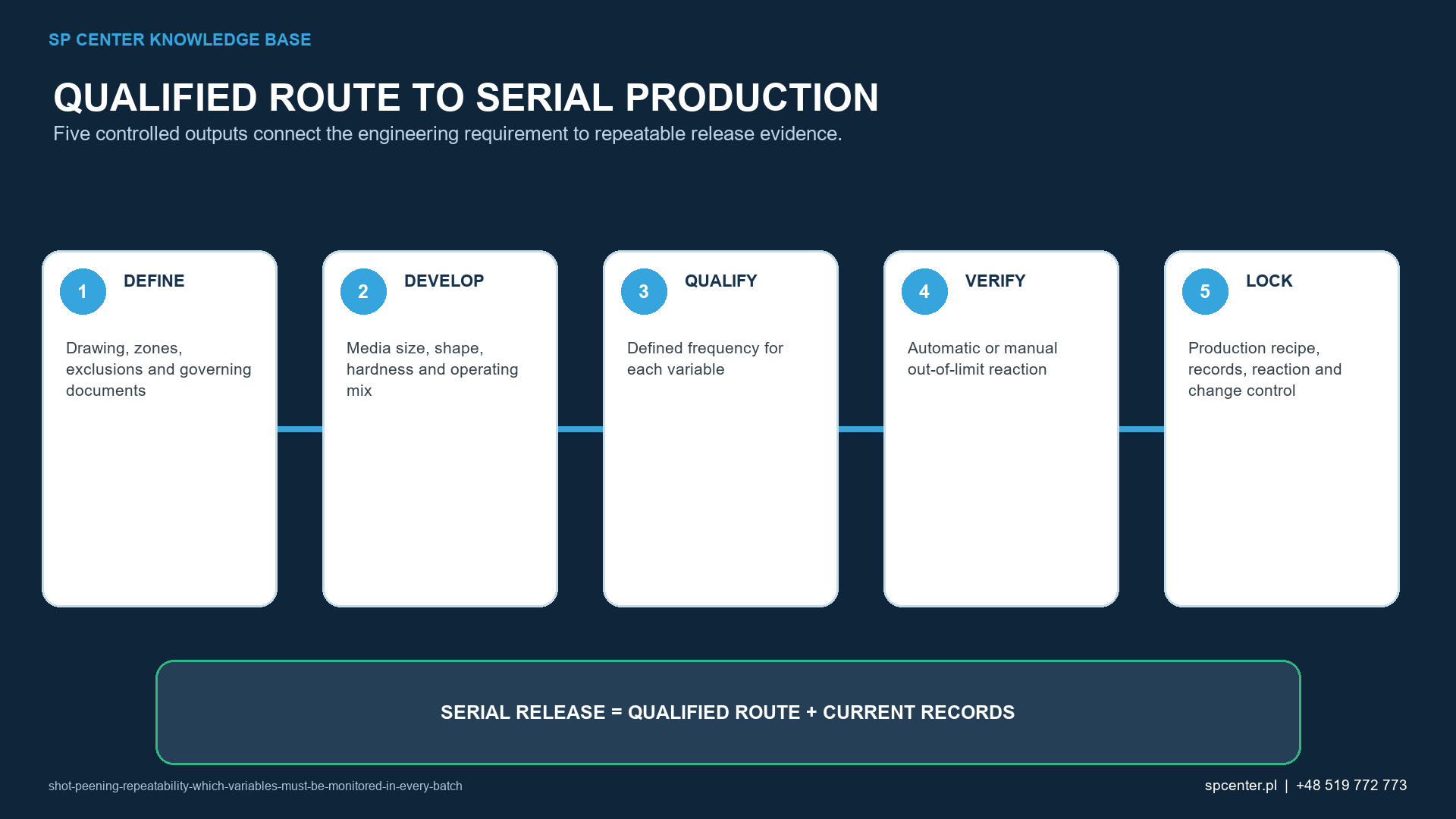
Machine, delivery system, media source or classification, software, program, sensor, fixture, nozzle, wheel, separator, maintenance method, material family, geometry, inspection method or specification revision can challenge repeatability evidence. Apply the approved change-control and requalification route before production use.
For Nadcap work, obtain the current applicable AC7117 criteria and supplements through PRI EAN and confirm the accredited and customer-approved scope. Nadcap accreditation does not release the batch and does not replace customer requirements.
What should the final release review confirm?
- Correct part and lot identity, quantity and requirement revisions.
- Approved machine, program, fixture, media and treatment route.
- Complete required cycle data without unexplained alarms or gaps.
- Valid intensity evidence and saturation basis where invoked.
- Required component coverage and surface, dimensional and cleanliness acceptance.
- Resolved deviations, rework and nonconformities with authorized disposition.
- Reviewer identity, release status and record retention.
Release only the quantity supported by complete evidence. If records cannot reconstruct what occurred, the lot remains suspect until an authorized evaluation establishes disposition.
Frequently asked questions
Which variables must be monitored in every shot peening batch?
At minimum, verify the invoked requirements, product identity, approved machine-program-fixture-media configuration, required cycle data, intensity and coverage checkpoints, component acceptance and release records. Exact frequency comes from the controlled job requirements.
Must every variable be measured continuously?
No. Some critical inputs may require continuous monitoring, while media analysis, saturation or component tests can be batch, shift or periodic. The governing specification and qualified control plan define the frequency.
Does stable air pressure prove a repeatable pneumatic process?
No. Air capacity, media mass flow, nozzle condition, distance, angle, motion, media state and the actual component result must also remain controlled.
Is Almen intensity a batch acceptance test for the part?
It is a required stream-control result when invoked, but it does not replace component coverage, surface, dimensional, cleanliness or other acceptance criteria.
Can a computer-monitored machine guarantee repeatability?
No. Sensors, scaling, alarms, data retention, bypass control, fixtures, media and component inspection must all be qualified and maintained.
What should happen after an alarm or missing process record?
Follow the approved reaction plan, preserve data, stop or contain as required, define the affected interval from the last verified state and obtain authorized disposition.
Should conforming values still be trended?
Yes, when useful and required. Trend review can detect drift before a limit is exceeded, but statistical monitoring does not replace individual acceptance requirements.
Does Nadcap prescribe one universal batch record?
No universal form should be assumed. Use the current applicable AC7117 criteria and supplements from PRI EAN together with customer, specification and internal controlled requirements.
Key takeaways
- Repeatability is the controlled result, not an unchanged setpoint.
- Define the batch before production and preserve product traceability.
- Separate continuous, cycle, batch, shift and periodic controls.
- Monitor the operating media mix, not only new-media certificates.
- Keep intensity, coverage and component acceptance separate.
- Use alarms and trends with explicit containment and reaction rules.
Related SP Center guides
- Shot Peening Media Quality Control
- Air Pressure and Flow in Pneumatic Shot Peening
- Shot Peening Fixtures
- Shot Peening Process Window
Technical references
1. SAE AMS2430U: Shot Peening, revised April 2018
2. SAE AMS2432E: Shot Peening, Computer Monitored, revised October 2022
3. SAE J2441_202511: Shot Peening, stabilized November 2025
4. SAE ARP7488: Peening Design and Process Control Guidelines, issued January 2018
5. SAE J442_202602: Tools for Peening Intensity Determination and Verification, revised February 2026
6. SAE J443_202512: Procedures for Determining and Verifying Peening Intensity, revised December 2025
7. SAE J2277_202301: Shot Peening Coverage Determination, revised January 2023
8. Performance Review Institute, Surface Enhancement Nadcap Audit Criteria Review
9. Performance Review Institute, PRI EAN and Qualified Manufacturers List
Standards note: Verification points, frequencies, sampling and record fields must come from the complete controlled requirements applicable to the job. Do not infer a universal frequency from this guide.
Author: Paweł Kmieć
Discuss repeatability and batch records for shot peening: +48 519 772 773 | [email protected]